
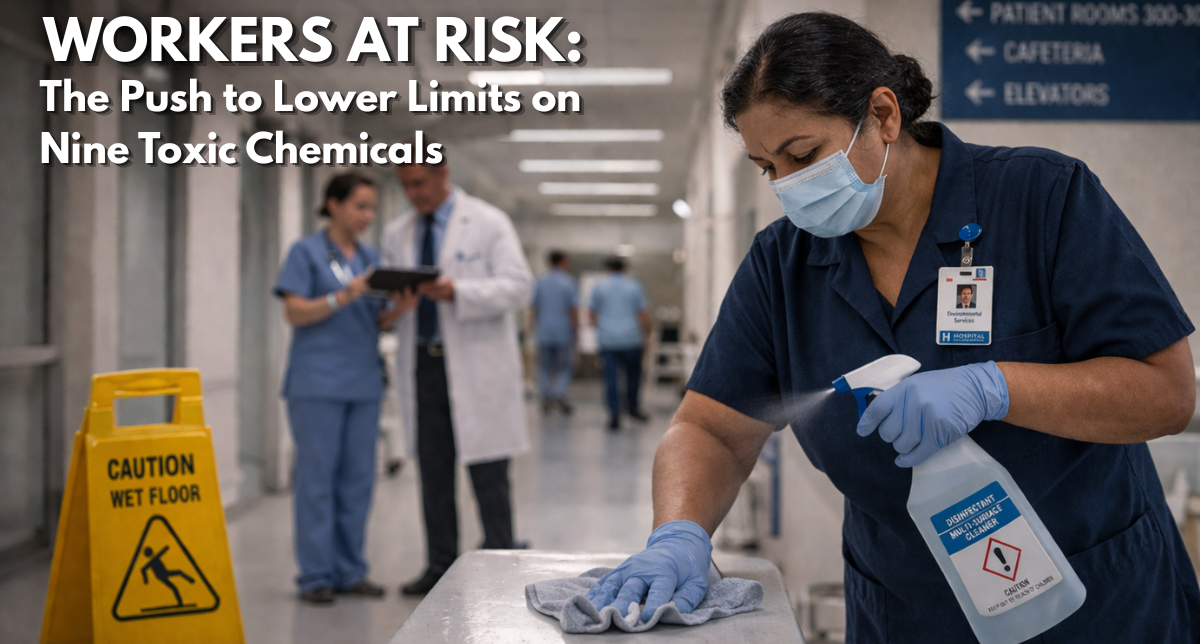
Workers at Risk: The Push to Lower Limits on Nine Toxic Chemicals
Written by Sue Chennell | Shared Safety and Risk | March 2026
A regulatory debate is currently unfolding in Australia — and for WHS, HR and risk professionals, now is the time to pay close attention.
Unions, public health bodies and worker advocacy groups have united in calling on Work Health and Safety Ministers to act on long-overdue expert recommendations to lower workplace exposure limits for nine hazardous chemicals. The campaign, led by the ACTU and co-signed by the Australian Nursing and Midwifery Federation (ANMF) and others, comes at a critical moment — as Australia prepares to transition to a new national Workplace Exposure Limits (WEL) framework on 1 December 2026.
“This isn’t just a regulatory compliance update. It’s a story about whether science-based protections for workers will be prioritised over concerns about regulatory burden.”
How Did We Get Here?
In April 2024, WHS Ministers agreed on updated workplace exposure limits for around 700 chemicals — a significant step forward in modernising how Australia protects workers from airborne contaminants.
However, nine chemicals were left off that list. Back in 2021, WHS Ministers requested further assessment after some employer groups claimed that evidence had not been adequately considered, and that the proposals would create significant regulatory burden.
Here’s the critical part:
Safe Work Australia has now completed those further assessments and confirmed — for a second time — that the existing exposure limits for these nine chemicals are failing to protect workers’ health.
Despite this, a final ministerial decision is still pending. Unions argue the continued delays are leaving workers unnecessarily exposed every single working day.
The Nine Chemicals
These are not obscure industrial substances. They are present across a wide range of everyday workplaces and industries. The nine chemicals under review are:
Formaldehyde, benzene, respirable crystalline silica, chlorine, copper, hydrogen cyanide, hydrogen sulphide, nitrogen dioxide and titanium dioxide.
ACTU research has found that more than 1 in 10 workers in Australia are regularly exposed to hazardous substances at work — including dusts, gases, vapours and fumes — that cause harm to health and can lead to illness, disease and premature death.
Workers most likely to be affected include:
Construction workers — respirable crystalline silica from cutting, drilling and grinding
Nurses and pathology technicians — formaldehyde in tissue preservation
Water treatment and utilities workers — chlorine and hydrogen sulphide
Pharmaceutical and manufacturing workers — benzene, nitrogen dioxide and titanium dioxide
Mining and resources workers — several chemicals across the list
Understanding the Transition: WES to WEL
If you haven’t already started planning for the December 2026 transition, this is your prompt.
From 1 December 2026, Workplace Exposure Limits will replace Workplace Exposure Standards across Australian jurisdictions. The change is designed to make clear that these are hard limits — not guidelines — and to align Australia with international terminology.
Until WHS Ministers make a final decision on the nine chemicals, PCBUs must continue to comply with the current exposure limits in the existing WES list.
But here’s the thing — “technically compliant today” is not the same as “adequately protecting your workers.” If Safe Work Australia has twice concluded that current limits are inadequate, then applying the precautionary principle now is not just good ethics — it’s good risk management.
What Should You Be Doing Right Now?
1. Check your chemical inventory
Identify whether any of the nine chemicals are present in your workplace and in what quantities and contexts.
2. Review and update your exposure assessments
Even where you are currently within WES limits, the regulatory direction of travel is clear. Working toward lower limits now is both prudent and defensible.
3. Strengthen your health monitoring program
For workers regularly exposed to any of these substances, ensure health monitoring arrangements are current, well-documented and responsive to changes in guidance.
4. Integrate your WHS and HR data
Occupational disease often accumulates quietly over years. Linking leave trends, health monitoring records and incident data will help you identify emerging exposures before they become serious harm.
5. Prepare your documentation
In an evolving regulatory environment, clear records of your risk assessments, control measures, consultation and decision-making will be critical in demonstrating due diligence.
6. Stay across Safe Work Australia’s transition guidance
Safe Work Australia is actively developing guidance and support materials to help PCBUs prepare for the new Workplace Exposure Limits. Make sure you’re accessing these as they become available.
The Bigger Picture
Occupational disease rarely announces itself dramatically. Unlike a workplace injury, it accumulates slowly — years or decades of exposure, before harm becomes visible. By the time a diagnosis is made, the exposure has long since happened.
That’s why waiting for Ministers to finalise a decision before taking action is not an approach we’d recommend. The evidence is in. The science has spoken — twice. Organisations that are genuinely committed to worker health, rather than simply aiming to stay technically compliant, will act ahead of the regulatory curve.
This matters not just for your workers, but for your organisation. Demonstrating that you have applied a precautionary and evidence-based approach to chemical exposure is the hallmark of effective WHS governance.
Work with Us
At Shared Safety and Risk, we work alongside WHS, HR and risk teams to translate complex regulatory developments into practical, people-centred action.
Whether you need support reviewing your current chemical exposure arrangements, updating your exposure assessment processes, preparing for the December 2026 WEL transition, or building a more integrated approach to hazardous substances management — we can help.
Get in touch with our team today.
📧 info@sharedsafetyandrisk.com.au 📞 +61 0412 259 782 🌐 https://www.sharedsafetyandrisk.com.au/
