
Work From Home – The Legal Landscape
Two key developments landing at once — here’s how they differ
In the space of a few weeks, Victorian employers have been handed two significant — and quite different — developments on working from home. The Victorian Government is currently trying to legislate a statutory entitlement to work from home through the Equal Opportunity Amendment (Work from Home) Bill 2026.
Separately, the Fair Work Commission has issued a decision inserting a new working-from-home clause into the Clerks – Private Sector Award 2020. The two are often talked about in the same breath, but they take genuinely different approaches, sit in different legal systems, and are at different stages of actually taking effect. Here’s what each one does, and what it means for your organisation.
The Victorian Bill — what’s proposed
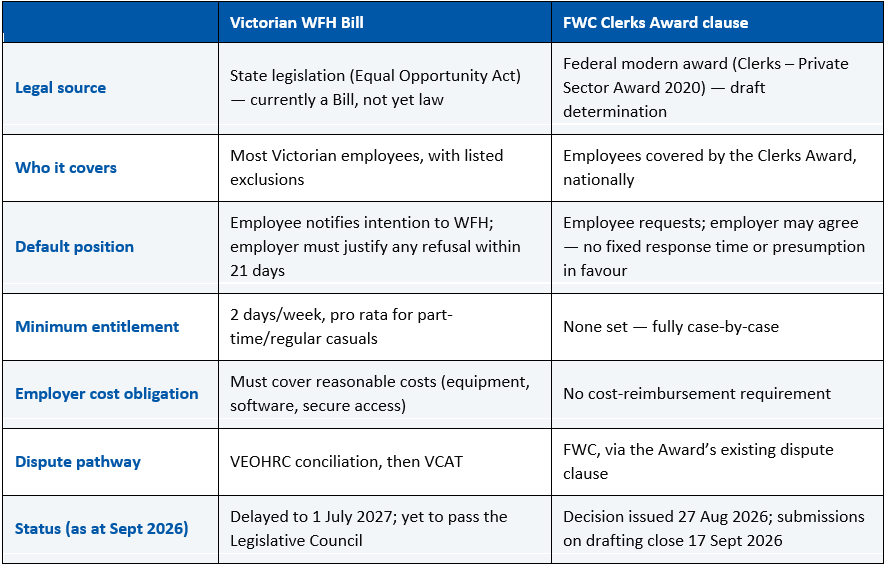
The Equal Opportunity Amendment (Work from Home) Bill 2026 would give eligible Victorian employees a statutory entitlement to work from home two days a week (pro rata for part-time and regular casual employees), where it is reasonably practicable to do so. Employees give written notice of their intention to work from home, specifying days, times and location, and the onus shifts to the employer to justify a refusal.
Key features as introduced:
Response window: employers have 21 days to respond, either approving the arrangement or setting out specific, reasonable grounds for refusing or offering an alternative.
Reasonableness test: employers may only weigh defined factors — the inherent requirements of the role, and documented impacts on productivity, safety, training, client relationships, customer service, data security and cost.
Cost coverage: employers must pay reasonable costs of enabling the arrangement, including essential equipment, software and secure system access.
Exclusions: probationary employees, apprentices, trainees, interns, irregular casuals, gig workers and sole traders, and employees who elect to instead use the existing flexible work provisions in the Fair Work Act.
Disputes: unresolved matters go to the Victorian Equal Opportunity and Human Rights Commission for conciliation, and from there can escalate to VCAT, which can make compliance orders or award compensation.
Timeline — where the Bill actually stands
The Bill was introduced on 16 June 2026 and passed the Legislative Assembly on 30 July 2026, but it has not yet passed the Legislative Council and is not yet law. Commencement was originally set for 1 September 2026 (1 July 2027 for small businesses), but on 11 August 2026 Premier Ben Carroll announced the start date would be pushed back to 1 July 2027 for all employers, following sustained pushback from business groups.
As of last week the Bill did not pass the upper house in an 18-17 narrow vote and has now been referred to a Parliamentary Committee to investigate it’s economic impact.
Given Victoria’s state election due in November 2026, it is unlikely to pass in this term of parliament and the final shape of the laws and timing remain genuinely uncertain.
Meanwhile, the Fair Work Commission Decision
On 27 August 2026, a Full Bench of the Fair Work Commission issued its decision on working from home in the Clerks – Private Sector Award 2020, inserting a new clause 5A. Unlike the Victorian Bill, this is a facilitative mechanism, not a statutory entitlement: an employee may request to work from home in writing, and the employer may agree , there is no presumption in favour, no fixed response timeframe, and no minimum number of days set.
Where an arrangement is agreed, it must be documented and free of coercion, the employer must keep records and provide the employee a copy, and the agreed arrangement becomes a protected “workplace right” under the Fair Work Act. The clause also allows agreed variations to some award provisions — such as the spread of ordinary hours and rest and meal break arrangements — to better suit a work-from-home arrangement. Disputes are handled through the Award’s existing dispute resolution clause.
Notably, the Full Bench explicitly rejected a stronger “right to request” model pushed by the ACTU and the ASU — which would have included a 14-day employer response time, a presumption in favour of approval, an exhaustive list of permitted refusal grounds, employer-funded equipment, no reduction in pay, and 26 weeks’ notice to end an arrangement. The Commission found the evidence didn’t show employers were refusing requests on arbitrary or discriminatory grounds, and that working from home is already “entrenched” in clerical and administrative work. So a mandatory model wasn’t necessary to satisfy the modern award’s objective. The decision is currently a draft determination; submissions on drafting and technical issues close 5:00pm AEST on 17 September 2026, and the Commission has signalled the new clause may become a model for other awards.
How the two compare
What this means for your organisation
For most employers, the practical starting point is the same regardless of which reform lands first, or in what shape: working from home is no longer an ad hoc arrangement handled case by case with no paper trail. Both developments point toward more formal, documented processes with written requests, defined response times, clear reasons for any refusal, and proper record-keeping.
If you're a Victorian employer, and particularly if you have clerical or administrative staff covered by the Clerks Award, it's worth watching both threads. The Bill (if and when it passes) would sit in state equal-opportunity law, alongside not instead of the federal award and enterprise agreement framework your employees are covered by. How the two interact for national employers isn't yet settled either! That's a genuine grey area, and one where it's worth getting tailored legal advice for your specific circumstances.
In the meantime, sensible groundwork applies either way: review or draft a working-from-home policy that sets out how requests are made and assessed, train people leaders on the reasonableness factors likely to matter (productivity, safety, client service, data security), and make sure your incident and hazard reporting processes already extend properly to home workspaces — an obligation that doesn't wait for either of these reforms to take effect.
We'll keep tracking both the Bill's progress through Parliament and the Commission's final determination, and will update our clients as either firms up. If you'd like a hand reviewing your current WFH policy and WHS considerations against what's coming, feel free to get in touch. info@sharedsafetyandrisk.com.au
