
Psychosocial Risk Management
What is Psychosocial Risk (and why it matters now)?
Psychosocial risks are the workplace factors, things like high job demands, low control, poor support, bullying, or excessive workload, that can harm a worker's mental and physical health in the same way an unguarded machine or a slippery floor can cause physical injury.
They matter because the harm doesn't stay contained to mental health: sustained psychosocial risk is linked to real physical outcomes too, including increased cardiovascular disease and musculoskeletal injury risk, alongside higher absenteeism, turnover, and workers' compensation claims.
Under WHS laws across all jurisdictions, psychosocial hazards must be managed with the same rigour as physical hazards — not treated as a wellbeing nice-to-have. Identifying and managing them ongpingly is both a legal duty and a practical way to protect your people and your business.
Our approach
ISO45003 and relevant legislation and Codes of Practice set the overall framework, but we don't believe in a one-size-fits-all approach.
What's right for an organisation just starting its psychosocial risk journey looks different to what's right for one with a mature safety culture already in place. Every engagement is bespoke, shaped around your organisation's structure, industry, and current maturity.
Protective Factors
Co-Design Practical Risk Controls
Ongoing Risk Control Review
Multidisciplinary, collaborative with Executive sponsorship
Genuine Consultation (qualitative and quantitative)
We take a multidisciplinary, holistic view from the outset — starting with senior leaders and working across the areas that shape psychosocial risk day to day, including HR, risk, operations, legal, and often IT and finance too. Just as important is genuine consultation with your workforce, using evidence-based methods like surveys, focus groups, and one-on-one interviews to understand how people actually experience their work and workplace.
Alongside data points that identify hazards, we deliberately look for what's already protecting your people — things like co-worker and leader support, the relational quality of work, and recognition — because sustainable risk management builds on strengths as much as it addresses gaps.
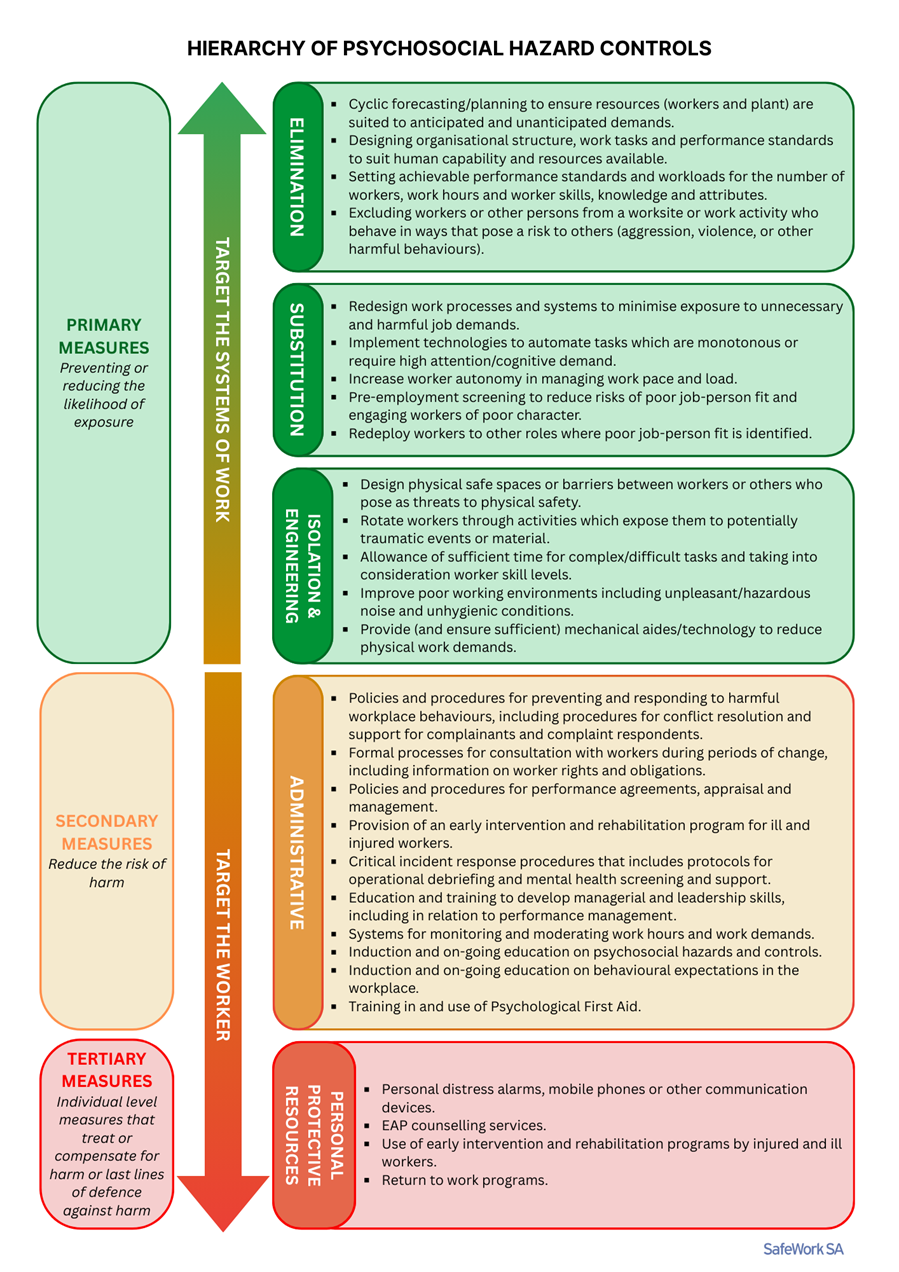
From there, we co-design practical, proportionate controls with you, applying the hierarchy of controls to build a management plan your organisation can genuinely own and act on.
Who is this for?
The legal psychosocial risk obligations sit across all industries. We have key experience in assisting clients in the construction, healthcare, family services, financial services, aged care and retail sectors.
Frequently Asked Questions (FAQs)
What are psychosocial hazards under WHS laws?
Under Australia's model Work Health and Safety (WHS) laws, a psychosocial hazard is any aspect of how work is designed, organised or managed or any workplace interaction, behaviour, or environment that could cause a stress response, which in turn may lead to psychological or physical harm. Since amendments to the model WHS Regulations, most states and territories now list psychosocial hazards explicitly alongside physical hazards as something a person conducting a business or undertaking (PCBU) has a legal duty to identify, assess and manage.
Common examples include high or low job demands, low job control, poor support from supervisors or co-workers, poor workplace relationships, role conflict or lack of clarity, exposure to traumatic events, remote or isolated work, poor organisational justice or change management, inadequate reward and recognition, and bullying, harassment (including sexual harassment), or workplace violence.
How often should psychosocial risks be assessed?
There's no single fixed interval set in WHS law instead, the Codes of Practice frame it as an ongoing, cyclical process rather than a once-a-year tick-box exercise. That said, several specific triggers should prompt a review regardless of when your last assessment was: a workplace change likely to affect risk (restructuring, new systems, changes to staffing or workload), a new hazard or risk being identified, a control measure that isn't working, feedback or complaints (including informal ones) from workers, or a request from a worker or HSRs who reasonably believes a review is needed.
In practice, most organisations combine both approaches: a structured formal assessment on a regular cycle, commonly annually, or more often in higher-risk or rapidly changing environments — supplemented by continuous, lighter-touch monitoring in between, such as ongoing worker consultation, monitoring of complaints and data, and checking in after any significant change.
How should we consult with workers about psychosocial risk?
Under WHS law (Section 47 of the WHS Act), you have a legal duty to consult "so far as is reasonably practicable" with workers directly affected by psychosocial risk. In practice, effective consultation usually combines several methods rather than relying on one: anonymous worker surveys, focus groups and team meetings for shared discussion, and one-on-one interviews for sensitive topics like bullying or harassment. Using a mix and tailoring it to your workforce tends to surface a far more accurate picture than any single method alone.