
New Workplace Exposure Limits for airborne contaminants — what's changing, and what to do before December 2026
Safe Work Australia is replacing the Workplace Exposure Standards (WES) list with a new Workplace Exposure Limits (WEL) list from 1 December 2026 — the first full review of these limits since 2003. The rename is deliberate. It signals a hard ceiling that must not be exceeded, rather than a target to work towards. Some limits are tightening, some contaminants are being added for the first time, and a group of carcinogens is moving to a different regulatory model altogether. Here's what's actually changing, who it affects, and what to do before it lands.
The key changes
New name, same idea, sharper intent: the WES list becomes the WEL list, explicitly framed as limits not to be exceeded and aligned with international terminology. Stricter limits for roughly 160 chemicals.
31 new substances added: including diesel particulate matter, flour dust, Bisphenol-A and PVC dust.
Welding fume cut from 5 to 1 mg/m³: one of the most significant single reductions, with direct flow-on effects for ventilation, PPE and monitoring in welding-heavy operations.
33 non-threshold genotoxic carcinogens (NTGCs) delisted: substances like acrylamide, vinyl chloride and benzidine lose their numeric limit entirely, moving instead to an elimination/minimisation standard. The intent shifts from “stay under X” to “there is no safe level.”
9 chemicals held over for further analysis: benzene, chlorine, copper, formaldehyde, hydrogen cyanide, hydrogen sulphide, nitrogen dioxide, respirable crystalline silica and titanium dioxide keep their current limits for now, pending additional impact assessment.
Victoria runs its own process, but the same intent and date: because Victoria sits outside the harmonised model WHS laws, WorkSafe Victoria had to run a separate consultation and Regulatory Impact Statement) to adopt the WEL list under the OHS Act 2004. It has landed on the same 1 December 2026 date, but the legal mechanism is different.
Timeline
The current WES list keeps applying right up until 30 November 2026. The new WEL list takes effect nationally, including in Victoria, from 1 December 2026. Safe Work Australia has developed numerous supporting guidance on their website.
Who this affects — example industries
The changes touch almost any workplace with airborne chemical hazards, but the practical impact varies a lot by sector. A few examples:
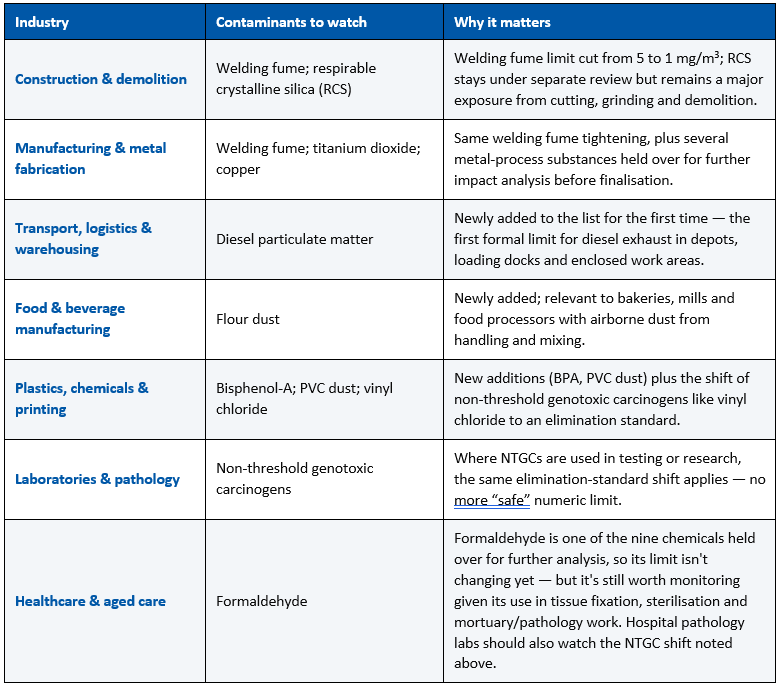
Steps to take before December 2026
Audit your chemical and hazardous substances register against the new WEL list, not just the substances you already monitor. The newly added contaminants (diesel particulate matter, flour dust, BPA, PVC dust) are easy to miss if they weren't previously listed.
Flag anything moving to a tighter limit or to elimination status. Welding fume and the 33 NTGCs are the two clearest priorities, don't wait until November to start on these.
Commission air monitoring where relevant. Establish whether current exposure levels will sit above or below the new limits, particularly for welding fume.
Start substitution and elimination planning for NTGCs now. Where a genotoxic carcinogen is in use, the direction of travel is toward replacing it, not just controlling exposure to a lower number.
Update the paperwork: Safety Data Sheets, risk assessments, Safe Work Method Statements and any health monitoring programs should all reference the WEL list once it's in force.
Review controls, not just numbers. A tighter limit often means engineering controls (ventilation, extraction) or PPE need reassessing. A documented number change means little without a matching control review.
